
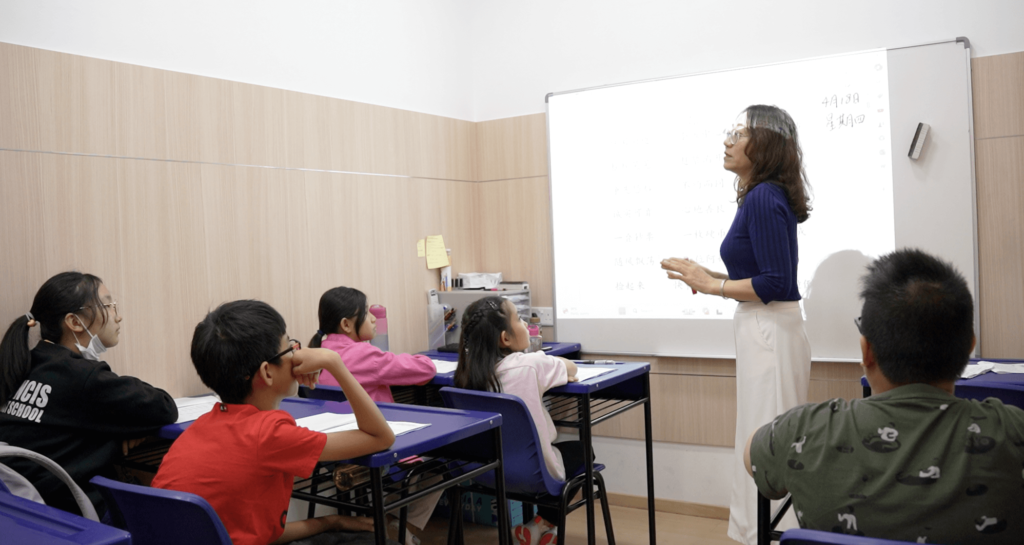
The best Chinese tuition in Singapore is not necessarily the centre with the biggest name, the most branches or the hardest worksheets. It is the programme that matches your child’s current Chinese level, confidence, school stage and specific areas for improvement.
One child may speak Mandarin comfortably but struggle to read independently. Another may recognise many words yet have difficulty organising a composition. An upper-primary student may understand a comprehension passage but lose marks because answers miss important points. A secondary student may know what they want to say but lack the vocabulary or structure to express a mature opinion clearly.
Parents should therefore compare Chinese tuition centres according to teacher fit, curriculum progression, feedback quality, coverage of the child’s weakest language skills and whether the programme is practical enough to attend consistently.
Yu Cai Education Centre provides Chinese programmes for children aged 4 to 17, progressing from preschool reading and writing through Primary 1 preparation, Primary 1 to Primary 6 comprehensive learning, creative writing, Higher Chinese and secondary-level Chinese. The centre describes its approach around progressive curriculum, customised teaching, professional teachers and continuous Chinese-language development.
This guide explains how parents can compare Chinese tuition in Singapore objectively, identify what their child actually needs, understand how Chinese-learning requirements change with age and decide whether Yu Cai or another programme is the right fit.
What Does “Best Chinese Tuition” Actually Mean?
There is no single Chinese tuition centre that is automatically best for every child.
A programme may be excellent for a confident Higher Chinese student but poorly suited to a Primary 2 child who has become nervous about speaking Mandarin.
Another centre may produce difficult worksheets and strong examination preparation but offer too little support for a student whose real weakness is basic vocabulary.
The word “best” should therefore describe fit, not popularity.
A strong tuition programme should be able to explain what your child currently struggles with, what skills will be taught, how those skills become more difficult over time and how parents will know whether improvement is taking place.
It should also recognise that Chinese is more than one subject skill.
Singapore’s primary Chinese Language curriculum develops listening, speaking, reading, writing and interaction skills, with different levels of support or enrichment according to students’ abilities.
Good tuition should strengthen the weakest area without reducing Chinese to endless worksheet practice.
The Five-Factor Chinese Tuition Fit Test
Parents comparing Chinese tuition centres can use five questions to judge whether a programme is genuinely suitable.
Learning Gap
First identify what the child actually needs help with.
A vague statement such as “my child is weak in Chinese” is not enough.
Does the student struggle to understand vocabulary?
Can they speak but not read?
Do they understand comprehension passages but write incomplete answers?
Do compositions lack ideas, organisation or vocabulary?
Is oral Chinese the main weakness?
The clearer the learning gap, the easier it becomes to judge whether a tuition programme addresses it.
A centre that recommends exactly the same intervention for every student may not be responding closely enough to individual needs.
Teacher Fit
A teacher’s subject knowledge matters, but so does their ability to explain that knowledge at the student’s level.
A strong Higher Chinese student may benefit from demanding corrections, nuanced vocabulary and more sophisticated discussion.
A child who has lost confidence in Mandarin may need smaller steps, more encouragement and additional opportunities to answer before being pushed into difficult work.
Yu Cai states that it uses a rigorous teacher-selection process, that the majority of its teachers are registered with Singapore’s Ministry of Education and that Higher Chinese teachers must meet additional Chinese-language proficiency expectations. These are Yu Cai’s own published teacher credentials and should be considered alongside how an individual teacher actually interacts with the child.
Qualifications matter, but the trial-class experience matters too.
Curriculum Progression
Parents should be able to see what becomes more difficult as the child grows.
Preschool Chinese should not resemble Primary 5 Chinese with easier worksheets.
Likewise, Primary 6 lessons should not simply repeat lower-primary activities using more complicated vocabulary.
A strong curriculum develops reading, vocabulary, speaking, listening, writing, comprehension and examination skills progressively.
Yu Cai’s current course pathway begins with nursery and kindergarten reading and writing, followed by Primary 1 preparation and Comprehensive Learning from Primary 1 to Primary 6. Older primary students can move into Creative Writing or Higher Chinese, while secondary programmes include G2/G3 Chinese, Higher Chinese and a Secondary 3–4 programme that Yu Cai currently labels “Express Chinese.”
That kind of pathway allows parents to understand what comes next rather than choosing a new tuition approach every year.
Feedback and Practice
More homework does not automatically mean better tuition.
What matters is whether the child understands why an answer was wrong and what they should do differently the next time.
For comprehension, feedback might identify that an answer did not address the question fully.
For composition, it might show that the problem is not grammar but weak organisation or insufficient detail.
For oral Chinese, feedback might focus on expanding short answers, improving pronunciation or explaining opinions more clearly.
Parents should ask how written work is marked, how corrections are explained and whether recurring mistakes are tracked.
Progress is more meaningful when the student becomes less dependent on the teacher over time.
Sustainability
The final factor is practical but often overlooked.
An excellent class is difficult to benefit from when attending it becomes exhausting every week.
Consider travel time, lesson duration, homework load, school activities and whether the child is already attending several other classes.
A slightly less famous centre that the child can attend consistently may provide better long-term value than one requiring an exhausting cross-island journey.
The best tuition is a programme the child can realistically sustain.
Which Chinese Skill Does Your Child Actually Need Help With?
Chinese ability develops through several connected skills.
A weakness in one area can affect another.
Listening
A child with limited listening comprehension may struggle to follow spoken instructions, identify details in audio passages or understand unfamiliar expressions in conversation.
More exposure to natural spoken Chinese can help, but students may also need strategies for identifying key information and understanding meaning from context.
Speaking
Speaking difficulties can appear as very short answers, hesitation, limited vocabulary or reluctance to participate.
A child may understand far more Chinese than they are comfortable using.
Oral practice should therefore create enough opportunities for students to speak, respond and explain ideas rather than spending the entire lesson listening to the teacher.
Reading
Reading difficulties often involve vocabulary, character recognition or understanding longer sentences.
A child may be able to pronounce individual words without understanding the passage as a whole.
As students progress, reading also requires them to identify sequence, purpose, character motivation, viewpoints and implied meaning.
Writing
Writing can fail for several different reasons.
Some students lack vocabulary.
Others have ideas but struggle to organise them.
Some rely heavily on memorised phrases that do not fit the topic.
The most useful tuition identifies the reason the writing is weak instead of simply providing another model composition.
Interaction
Chinese is also a communication tool.
MOE’s current primary curriculum specifically includes interaction alongside listening, speaking, reading and writing.
Students increasingly need to respond appropriately, explain viewpoints and communicate according to different situations rather than simply recall vocabulary.
This broader perspective is useful when comparing tuition centres.
A programme that strengthens examination performance while also helping the child use Chinese more confidently is generally providing deeper language support.
How Do You Know Whether Your Child Needs Chinese Tuition?

One disappointing test does not automatically mean tuition is necessary.
Look for repeated patterns instead.
A younger child may regularly avoid reading Chinese aloud, depend heavily on adults to explain common words or become frustrated whenever Chinese homework appears.
A primary student may repeatedly make similar comprehension mistakes, struggle to develop composition ideas or spend disproportionately long periods completing Chinese work.
An older student may understand lessons but have difficulty with longer passages, emails, essays, summaries, oral discussion or more abstract vocabulary.
Confidence is another important signal.
Students who repeatedly struggle may eventually stop volunteering answers because they expect to be wrong.
That reduces the amount of practice they receive and can make the problem more difficult to reverse.
Tuition is most useful when it addresses a specific pattern rather than becoming an automatic response to every disappointing score.
What Chinese Tuition Is Suitable for Preschool Children?
Preschool Chinese should focus on familiarity, communication and early literacy rather than examination pressure.
Children aged around 4 to 6 are still developing vocabulary, attention, fine motor skills and confidence speaking in groups.
Lessons can introduce character recognition, simple reading, writing readiness, listening and spoken Chinese through age-appropriate activities.
Yu Cai’s current pathway begins with N2 Fun Reading and Writing and K1–K2 Fun Reading and Writing as part of its programme range for children aged 4 to 17.
At this stage, the aim should not be to rush children into difficult written exercises.
A stronger foundation is created when Chinese becomes familiar enough that entering primary school does not feel like starting a completely foreign subject.
Parents should look for lessons where younger children are encouraged to listen, speak, recognise words and participate rather than simply complete written pages.
How Can Chinese Tuition Prepare a Child for Primary 1?
Primary 1 introduces more formal Chinese learning.
Children need to follow classroom instructions with greater independence, recognise more words, complete written tasks and become comfortable using Chinese in a structured school environment.
Yu Cai offers a dedicated Primary 1 preparatory programme before students move into its Primary 1 Comprehensive Learning pathway.
For children who use mostly English at home, additional Chinese exposure before Primary 1 may make the transition less abrupt.
However, preparation should not become premature examination training.
Reading readiness, vocabulary, character familiarity, listening and willingness to participate remain more important than completing advanced worksheets early.
What Should Primary Chinese Tuition Cover?
Primary-school Chinese becomes progressively more demanding because children need to develop several language skills at the same time.
Vocabulary affects reading.
Reading affects comprehension.
Vocabulary and comprehension affect oral responses.
All of these influence composition.
MOE’s Chinese curriculum develops listening, speaking, reading, writing and interaction, so parents should look for tuition that supports the relevant combination rather than focusing on only one examination component.
Yu Cai provides Comprehensive Learning programmes from Primary 1 through Primary 6, together with specialised Creative Writing for Primary 3 to Primary 6 and Higher Chinese for Primary 5 and Primary 6.
Upper-primary students generally need greater precision.
Understanding a passage is no longer enough.
They need to identify what the question is asking, select the correct information and write an answer that includes the relevant points.
Yu Cai’s Primary 6 Higher Chinese curriculum, for example, includes vocabulary consolidation, comprehension-answering methods, written responses, composition, oral preparation and listening practice.
How Can Chinese Tuition Improve Composition?
Chinese composition improves when children learn how to generate, organise and express ideas rather than simply memorise impressive phrases.
Yu Cai currently provides dedicated Creative Writing programmes for Primary 3–4 and Primary 5–6.
Younger writers first need to understand what is happening in a picture or prompt and organise those events logically.
They then need to add suitable actions, emotions, dialogue and thoughts.
Upper-primary writing requires greater depth.
Students must decide which details matter, organise paragraphs, vary their language and create an ending that relates meaningfully to what happened earlier.
One useful indicator for parents is whether the child can explain the story plan before beginning to write.
A student who understands the intended opening, development, turning point and ending has a stronger foundation than one who immediately writes memorised sentences and hopes they fit the topic.
Parents should also compare older and newer pieces of work.
Look for clearer organisation, more relevant detail, stronger vocabulary and fewer repeated corrections.
That provides better evidence of progress than a single impressive composition.
Who Should Consider Higher Chinese Tuition?
Higher Chinese requires a stronger level of language proficiency and generally involves deeper vocabulary, reading, writing and expression.
Yu Cai currently offers Higher Chinese for Primary 5 and Primary 6 and from Secondary 1 through Secondary 4.
Its Primary 6 Higher Chinese curriculum includes vocabulary review, summarisation, comprehension-answering methods, written responses, situational and full compositions, oral expression and listening comprehension.
There is also an important 2026 development for parents to understand.
From the 2026 Secondary 1 cohort, MOE says eligibility to offer Higher Mother Tongue Language at the start of Secondary 1 is no longer dependent on the student’s overall PSLE score. Students who achieve AL1 or AL2 in Mother Tongue Language, or Distinction or Merit in Higher Mother Tongue Language, may offer HMTL regardless of overall PSLE score.
This does not mean every strong student automatically needs Higher Chinese tuition.
Parents should consider support when the student has sufficient aptitude for the subject but finds the faster vocabulary growth, deeper reading or more demanding written expression difficult to manage independently.
What Does Secondary Chinese Tuition Need to Cover in 2026?
Secondary Chinese requires students to interpret longer texts and express increasingly mature ideas.
Singapore’s secondary system now uses Full Subject-Based Banding, where subjects are generally offered at G1, G2 or G3 levels rather than through the former stream structure.
Yu Cai currently offers Comprehensive Learning G2/G3 for Secondary 1 and Secondary 2 and Higher Chinese from Secondary 1 through Secondary 4. It also continues to use the label “Express Chinese” for one of its Secondary 3–4 programmes. That should be understood as Yu Cai’s programme name rather than the general terminology now used across the MOE system.
Yu Cai’s Higher Chinese curriculum includes vocabulary and idioms, grammar, summarisation of longer texts, rhetorical and descriptive techniques, personal and business emails, forum writing, narrative, expository and argumentative essays, oral preparation and listening comprehension.
At secondary level, good tuition should increasingly develop independence.
Students need to know not simply what the correct answer is but how to analyse a passage, organise an argument, develop an opinion and edit their own writing.
A student who still depends on the teacher to provide every idea may achieve short-term improvements without developing the independence needed for later levels.
How Should Parents Compare Chinese Tuition Centres in Singapore?
The most useful comparison uses the same criteria for every centre.
First ask how the centre determines the child’s level.
Then ask what the relevant class actually covers.
Find out how often students practise oral Chinese, comprehension and writing rather than assuming every programme is comprehensive.
Ask how compositions are marked and whether teachers explain corrections.
Find out how parents receive progress feedback.
Ask what happens when a child is significantly stronger or weaker than the rest of the class.
Then consider class environment.
A small class is not automatically better if the teacher does not interact with individual students. A larger class is not automatically worse when the lesson is well managed and students receive meaningful feedback.
Parents should also avoid judging a centre primarily by branch count, difficult worksheets, testimonials or claims that every student improves.
The strongest evidence is a curriculum you understand, a teacher who suits the child and progress you can observe in actual work.
Is a Trial Lesson Important Before Enrolling?
A trial class is one of the most useful ways to test tuition fit.
Yu Cai currently offers complimentary trial lessons and says parents can meet teachers during the registration process.
During the class, observe how much the child participates.
Does the teacher ask questions?
Does the child have opportunities to read or speak?
Does the teacher notice when the student is confused?
When an answer is wrong, does the explanation help the child understand why?
Also consider the level of difficulty.
A lesson can be enjoyable but too easy.
Another can be challenging but appropriate when the child feels supported.
After the class, avoid asking only whether the child liked it.
Ask what they learned.
Ask which part was difficult.
Ask whether the explanation made sense.
Ask what they think they could do better next time.
Those answers reveal more about the learning experience than a simple yes-or-no reaction.
How Much Does Chinese Tuition Cost in Singapore?
There is no single meaningful price for Chinese tuition in Singapore because fees vary according to school level, class size, lesson duration, teacher experience, location, materials and whether the programme is general Chinese, Higher Chinese or specialised writing.
Parents should therefore compare the total learning package, not just the monthly headline fee.
Ask whether registration and materials are charged separately, how many lessons are included, how long each lesson lasts and whether replacement lessons are available.
Also ask whether specialised workshops, examination preparation or additional materials involve extra charges.
Yu Cai’s main-centre tuition fees should be confirmed directly with the centre because current programme prices can vary by course and location.
For a concrete 2026 reference, OnePA currently lists several community Chinese enrichment programmes operated by Yu Cai Chinese Enrichment. Examples include S$80 for four Primary 1–2 sessions, S$85 for four Primary 3 sessions and S$90 for four Primary 5–6 sessions, with some listings also showing separate registration and material charges. These are specific community-course prices and should not be treated as the price of Yu Cai’s main-centre tuition programmes.
Price should ultimately be considered together with teaching quality, class fit and progress.
A cheaper class that does not address the student’s weakness can be poor value.
An expensive programme is also poor value when the child receives little meaningful feedback.
What Progress Should Parents Expect to See?
Progress in Chinese is not always visible immediately in a single examination score.
Parents can look for smaller changes first.
A child may begin reading with less hesitation.
Oral answers may become longer.
Comprehension responses may include more complete information.
Composition plans may become more organised.
The student may begin correcting common mistakes without being reminded.
Those behavioural changes often show that learning is becoming more independent.
Parents should compare marked work over time.
For writing, look at structure, vocabulary, detail and the types of errors the teacher continues to correct.
For comprehension, check whether the same answering mistakes keep recurring.
For oral work, ask whether the student can develop an opinion rather than giving only one-sentence answers.
A strong centre should be able to explain what progress it expects and what still needs improvement.
Where Are Yu Cai Chinese Tuition Classes Available?
Yu Cai currently lists four main centres in northern and north-eastern Singapore.
These are Woodlands Civic Centre, Northpoint City in Yishun, The Seletar Mall and Yishun Town Square.
The centre also lists community-based locations across Punggol and Sengkang, including Punggol Meridian, Punggol Damai, Punggol Parc Terrace, Punggol Seas, Punggol Jewel, Punggol West Community Centre, Sengkang West and Compassvale Ancilla.
Current OnePA listings independently identify Yu Cai Chinese Enrichment as the training provider for several community Chinese programmes in 2026.
For families living in the north and north-east, this can make weekly attendance more manageable.
Parents should still confirm the latest class level, timetable and vacancy at the preferred venue before registering.
What Makes Yu Cai Different as a Chinese Learning Pathway?
Yu Cai specialises in Chinese-language education rather than offering a large mixture of unrelated tuition subjects.
Its current pathway allows students to move from preschool reading and writing into Primary 1 preparation, Primary 1–6 comprehensive Chinese, specialised creative writing and Higher Chinese, followed by G2/G3 secondary Chinese, Higher Chinese and other secondary-level courses.
The centre describes its approach through progressive curriculum, customised teaching, expert guidance and comprehensive learning. It also states that most of its teachers are registered with MOE and that its Higher Chinese teachers are subject to additional Chinese-language proficiency requirements.
Yu Cai also works beyond its own centres.
Its current location information shows community-based classes around Punggol and Sengkang, while OnePA independently lists Yu Cai Chinese Enrichment as the training provider for several Chinese enrichment programmes.
For parents, the value of the overall pathway is continuity.
A child who begins needing confidence and basic language exposure can move towards increasingly demanding reading, writing, oral, comprehension and examination work without changing to an entirely different learning system at every stage.
That continuity is useful only when the programme continues to match the child, however.
Parents should reassess fit as the student grows rather than assuming that staying with one centre is automatically the best choice forever.
How Can Parents Support Chinese Learning at Home?
Tuition works better when Chinese does not disappear completely between lessons.
Parents do not need to become Chinese teachers.
Short, regular exposure can be more sustainable than turning home into a second classroom.
Younger children can read short passages aloud, talk about their day in Mandarin or discuss the characters in a story.
Primary students can explain what happened in a story before attempting a composition.
Older students can practise expressing an opinion on an everyday issue and explaining the reasons behind it.
Vocabulary becomes more useful when children encounter words repeatedly in meaningful contexts rather than memorising them once for a test.
Parents can also ask children to explain corrections on marked work.
Instead of simply rewriting the correct answer, ask why the original response lost marks and what should change next time.
The objective is understanding, not another long homework session.
Frequently Asked Questions About Chinese Tuition in Singapore
What Is the Best Chinese Tuition Centre for My Child?
The best centre is the one that matches your child’s current Chinese level, specific learning gaps, confidence and school stage. Compare teacher fit, curriculum progression, feedback, language-skill coverage, trial-class experience, location and total cost rather than choosing only according to popularity.
How Do I Know Which Part of Chinese My Child Is Weak In?
Look separately at listening, speaking, reading, writing and interaction. A child may speak confidently but struggle with reading, or understand passages but produce weak written answers. Marked schoolwork, oral performance and teacher feedback can help identify the actual gap.
When Should My Child Start Chinese Tuition?
There is no compulsory age. Some children benefit from additional exposure during preschool, while others cope well until a particular difficulty appears in primary or secondary school. Tuition is most useful when it addresses a clear need rather than being started simply because other children attend.
What Age Can Children Start at Yu Cai?
Yu Cai currently provides Chinese programmes for children aged 4 to 17. Its pathway begins with nursery and kindergarten reading and writing before progressing into Primary 1 preparation, primary programmes, creative writing, Higher Chinese and secondary Chinese.
Can Chinese Tuition Help With Composition?
It can help when the programme teaches children how to plan, organise and develop their own ideas rather than simply memorise model phrases. Effective writing support should address structure, vocabulary, description, relevance and recurring mistakes in marked work.
Does Yu Cai Offer Higher Chinese Tuition?
Yes. Yu Cai currently offers Higher Chinese for Primary 5, Primary 6 and Secondary 1 through Secondary 4.
What Changed for Higher Chinese in Secondary 1 in 2026?
From the 2026 Secondary 1 cohort, students who achieve AL1 or AL2 in PSLE Mother Tongue Language, or Distinction or Merit in Higher Mother Tongue Language, may offer Higher Mother Tongue at the start of Secondary 1 regardless of their overall PSLE score.
What Is the Difference Between G2/G3 Chinese and “Express Chinese”?
Singapore’s current Full Subject-Based Banding system generally describes subjects at G1, G2 and G3 levels. Yu Cai currently lists G2/G3 programmes for Secondary 1–2 and separately retains “Express Chinese” as the name of one Secondary 3–4 programme. The latter should be understood as Yu Cai’s course label rather than the current nationwide stream terminology.
Does Yu Cai Offer a Free Trial Lesson?
Yes. Yu Cai currently invites prospective students to attend a complimentary trial class and says parents may meet teachers during registration.
How Should I Judge a Chinese Tuition Trial Class?
Look at how much your child participates, whether the teacher checks understanding, how mistakes are explained and whether the difficulty level feels appropriate. After the class, ask your child what they learned and which part was difficult instead of asking only whether the lesson was fun.
How Much Does Chinese Tuition Cost?
Fees vary substantially according to level, teacher, location, lesson duration, class size and programme type. Parents should compare total term cost, lesson hours, registration and material charges, replacement-class policies and what feedback is included. Yu Cai centre fees should be confirmed directly because community-course prices and main-centre tuition are not the same.
Conclusion
Finding the best Chinese tuition in Singapore should begin with a more useful question than “Which centre is the most famous?”
Ask instead:
What does my child actually need next?
A preschooler may need positive exposure and early language confidence.
A lower-primary student may need stronger vocabulary and reading foundations.
An upper-primary student may require better comprehension-answering techniques, oral confidence or composition structure.
Higher Chinese and secondary students need increasingly sophisticated vocabulary, reading, writing, listening and spoken-expression skills.
Parents should compare tuition centres according to the child’s learning gap, teacher fit, curriculum progression, quality of feedback and whether the programme is sustainable for the family.
Yu Cai Education Centre provides a continuous Chinese-learning pathway for children aged 4 to 17, ranging from preschool and Primary 1 preparation to comprehensive primary Chinese, creative writing, Higher Chinese and secondary-level programmes. It also currently offers complimentary trial lessons and operates through its main centres as well as community-based programmes in northern and north-eastern Singapore.
The strongest tuition choice is not the one that creates the most homework.
It is the programme that helps the child understand their mistakes, develop the skills they are missing and gradually become less dependent on additional support.
When a student begins reading more independently, answering with greater precision, expressing ideas more confidently and correcting mistakes without waiting for an adult to intervene, tuition is doing something more valuable than preparing them for the next test.